G-HIP: A Wood-and-Rivets Flying Machine Caught Between Steampunk and Dieselpunk
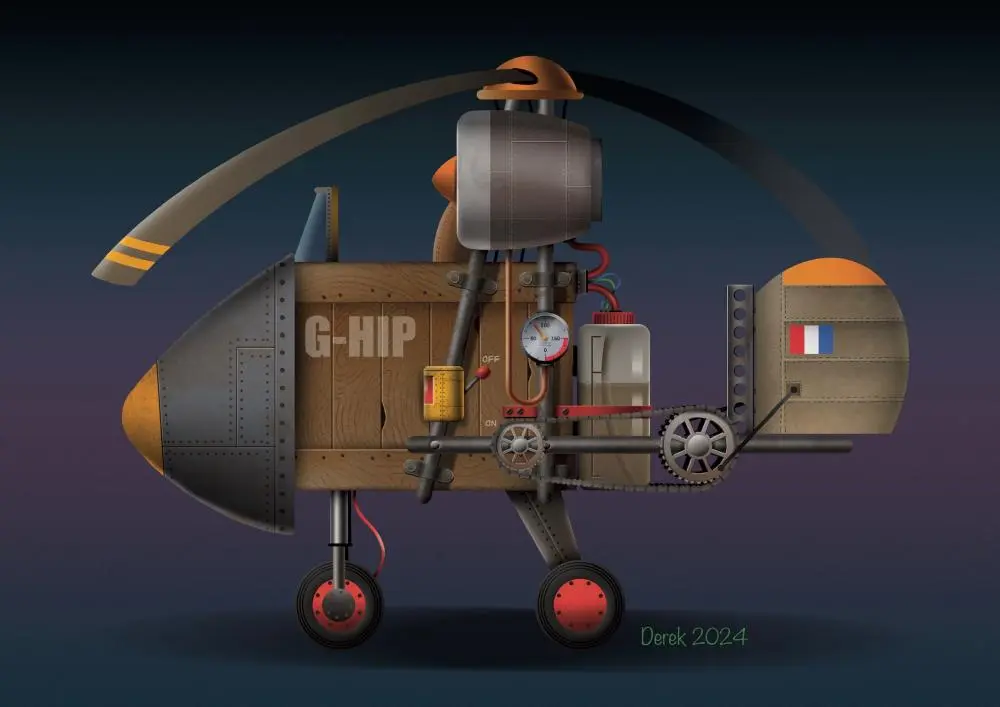 Every so often an illustration comes along that cheerfully refuses to sit inside a single genre — and Derek's 2024 piece, the gloriously improbable little helicopter registered G-HIP, is exactly that kind of delightful misfit. Part bicycle, part bomber, part garden-shed engineering project, it's a loving celebration of the retro-mechanical fantasy that fans of steampunk and dieselpunk adore. Let's take a closer look at the machine itself, unpack what those two genres actually mean, and see exactly where this charming contraption belongs.
First, the machine itself
At a glance, G-HIP shouldn't fly — and that's half the joke. Its fuselage is a plain wooden crate, complete with visible grain, plank seams and a stencilled British-style registration on the side. The lettering itself is a wink to aviation buffs: the Mil Mi-8 helicopter carries the NATO reporting name “Hip,” so a British-registered G-HIP is a quietly clever pun. The nose is a riveted metal cone tipped in amber, the tail sports a jaunty blue fin and a tricolour roundel borrowed from vintage military aircraft, and the whole thing rolls on fat, red-hubbed wheels that look as though they were pinched from an old pram.
Then there's the drivetrain, which is where the artwork really earns its grin. Power seems to come from a chunky industrial turbine perched on top — its gauge proudly labelled Pratt & Whitney — which somehow drives the overhead rotor through a bicycle chain looped over toothed sprockets. Copper plumbing snakes across the body, a pressure gauge hovers reassuringly short of the red zone, bundles of red, blue and green wires sprout from the engine, and a big yellow switch offers the pilot a beautifully simple choice: OFF or ON. A translucent plastic bottle stands in for a fuel tank. It is implausible, hand-built and entirely wonderful.
What is steampunk?
Steampunk is a genre of speculative fiction, art and design built around an alternate history in which steam power never surrendered to the petrol engine or the microchip. It draws its look and feel from the 19th-century Victorian and Industrial Revolution era, imagining a world where mechanical ingenuity simply kept advancing on brass, copper, polished wood, leather and clockwork.
The aesthetic is instantly recognisable: exposed cogs and gears, rivets, analogue dials, pressure gauges, goggles and grand airships drifting across the sky. Its spiritual ancestors are writers like Jules Verne and H. G. Wells, and the term itself was coined in the late 1980s. Above all, steampunk is optimistic, ornate and hand-crafted — it's the future as the Victorians might have dreamed it, gleaming and a little bit magical.
 What is dieselpunk?
Dieselpunk nudges the clock forward. Where steampunk lives in the age of steam, dieselpunk inhabits the diesel-and-electric world of roughly the 1920s to the 1950s — the interwar years, the machine age, and the heavy industry of the Second World War. Its visual language leans on Art Deco styling, riveted steel, raw mechanical power and the grease-stained glamour of pulp adventure serials and film noir.
If steampunk is brass and elegance, dieselpunk is iron and muscle. Think of the swaggering machines of Sky Captain and the World of Tomorrow, the retro-futurism of BioShock, or the goggled daredevilry of The Rocketeer. The mood is grittier and more utilitarian — function over filigree, with a tang of engine oil in the air.
So where does G-HIP fit?
Here's the fun part: G-HIP doesn't pick a side. It sits squarely on the seam between the two genres, and that's precisely what makes it such a treat.
Several details pull it toward steampunk — the warm wooden fuselage, the copper plumbing, the round analogue gauges, and the general sense that this thing was lovingly assembled by hand rather than mass-produced. Yet just as many details tug it toward dieselpunk: the riveted military-style nose and tail, the brutish industrial turbine, the no-nonsense OFF/ON switch, and the tricolour roundel that gives it the air of a weary little warbird.
Binding the two together is a spirit you find at the heart of both genres: improvised, make-do, folk-mechanical engineering. The bicycle-chain drivetrain and the plastic-bottle fuel tank are the same affectionate joke that runs through the best retro-tech fantasy — the idea that with enough rivets, wire and stubborn optimism, almost anything will fly. Derek's painterly finish, all warm timber and burnished metal glowing against a cool dusk-blue background, completes the illusion of a machine that is half blueprint, half daydream.
G-HIP is, in the end, a perfect little ambassador for this corner of imaginative design: a reminder that steampunk and dieselpunk aren't rigid categories but overlapping moods — two ways of asking the same playful question. What if the machines of the past had grown up differently?