The Pixart Blog of Things!
★ EXTRA! EXTRA! ★
The PIXart Gazette
Read All About It — Original Illustrations & Features
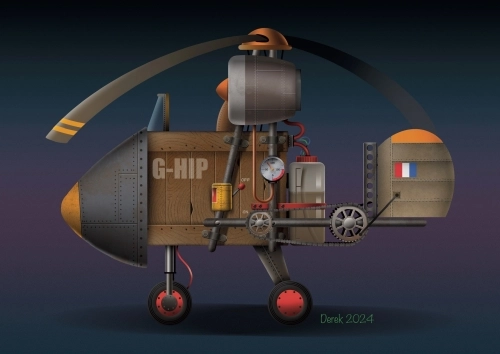
What Is Steampunk and Dieselpunk? A G-HIP Study
Steampunk and dieselpunk art often blur together — but is there a real relationship between the two styles? We explore the question through one curious flying machine.
Read More →
Unique Gift Ideas | Digital Art & Creative Gifts | Pixart
Meet Tally-Ho Tommy — five Luftwaffe kill markings stencilled under his cockpit and not a scratch on him to show for the trouble. A plucky little chibi biplane ace from the wood-and-wire school of dogfighting, our Tommy treats incoming Bf 109s as target practice and still beats his ground crew back to the mess for tea (or so I am told). Beautifully turned wooden propeller, a cheeky red spinner and an RAF roundel worn with quiet pride — this stout little fighter is available as a high-resol
Read More →
The Spark of Life: Philosophical Dialogue with Claude
Explore deep philosophical questions about consciousness, creativity and existence through an engaging, thought-provoking dialogue between artist Derek Johnson and Claude, the AI assistant.
Read More →
Does A.I have a place in the art world?
AI is being over-used to generate art, but art is meaningless without genuine emotion. Until something beyond AGI arrives, is there really a place for artificial intelligence in the art world?
Read More →
Pixart Now Available on Facebook | Official Launch
Pixart is now on Facebook. Follow the official page for new Chibi-style aircraft illustrations, behind-the-scenes work and updates, and to connect with a growing community of aviation art fans.
Read More →
Finally gotten around to launching my website!
After a lifetime of deliberation, Derek Johnson finally launched the Pixart online store to gauge interest in his Chibi-style aviation illustrations and original aircraft artwork. This is how it began.
Read More →G-HIP: A Wood-and-Rivets Flying Machine Caught Between Steampunk and Dieselpunk
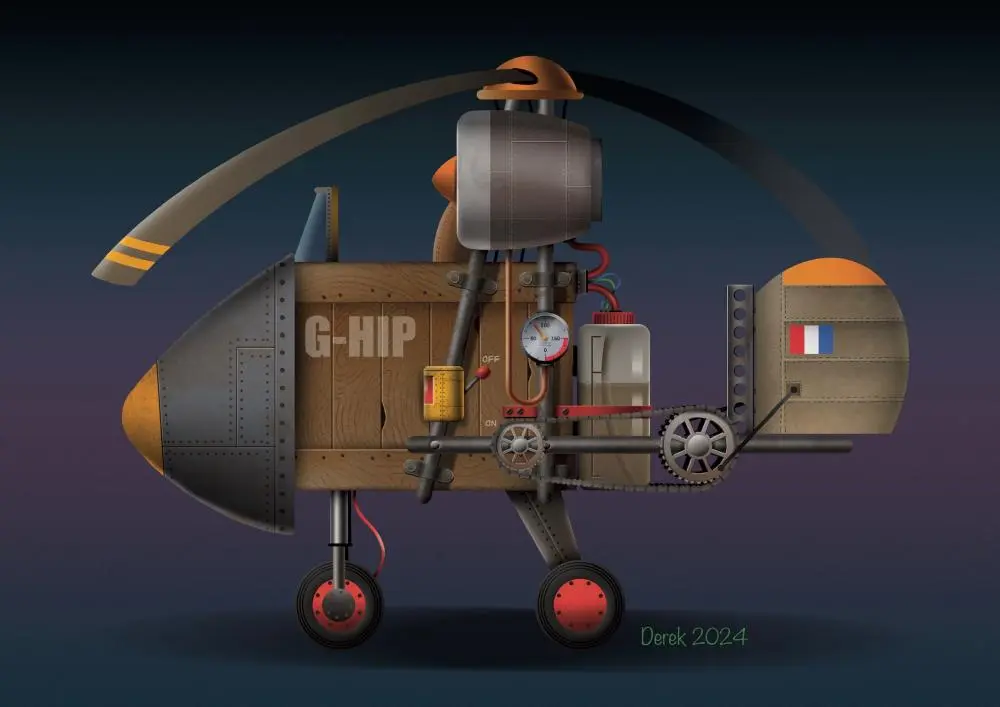 Every so often an illustration comes along that cheerfully refuses to sit inside a single genre — and Derek's 2024 piece, the gloriously improbable little helicopter registered G-HIP, is exactly that kind of delightful misfit. Part bicycle, part bomber, part garden-shed engineering project, it's a loving celebration of the retro-mechanical fantasy that fans of steampunk and dieselpunk adore. Let's take a closer look at the machine itself, unpack what those two genres actually mean, and see exactly where this charming contraption belongs.
First, the machine itself
At a glance, G-HIP shouldn't fly — and that's half the joke. Its fuselage is a plain wooden crate, complete with visible grain, plank seams and a stencilled British-style registration on the side. The lettering itself is a wink to aviation buffs: the Mil Mi-8 helicopter carries the NATO reporting name “Hip,” so a British-registered G-HIP is a quietly clever pun. The nose is a riveted metal cone tipped in amber, the tail sports a jaunty blue fin and a tricolour roundel borrowed from vintage military aircraft, and the whole thing rolls on fat, red-hubbed wheels that look as though they were pinched from an old pram.
Then there's the drivetrain, which is where the artwork really earns its grin. Power seems to come from a chunky industrial turbine perched on top — its gauge proudly labelled Pratt & Whitney — which somehow drives the overhead rotor through a bicycle chain looped over toothed sprockets. Copper plumbing snakes across the body, a pressure gauge hovers reassuringly short of the red zone, bundles of red, blue and green wires sprout from the engine, and a big yellow switch offers the pilot a beautifully simple choice: OFF or ON. A translucent plastic bottle stands in for a fuel tank. It is implausible, hand-built and entirely wonderful.
What is steampunk?
Steampunk is a genre of speculative fiction, art and design built around an alternate history in which steam power never surrendered to the petrol engine or the microchip. It draws its look and feel from the 19th-century Victorian and Industrial Revolution era, imagining a world where mechanical ingenuity simply kept advancing on brass, copper, polished wood, leather and clockwork.
The aesthetic is instantly recognisable: exposed cogs and gears, rivets, analogue dials, pressure gauges, goggles and grand airships drifting across the sky. Its spiritual ancestors are writers like Jules Verne and H. G. Wells, and the term itself was coined in the late 1980s. Above all, steampunk is optimistic, ornate and hand-crafted — it's the future as the Victorians might have dreamed it, gleaming and a little bit magical.
 What is dieselpunk?
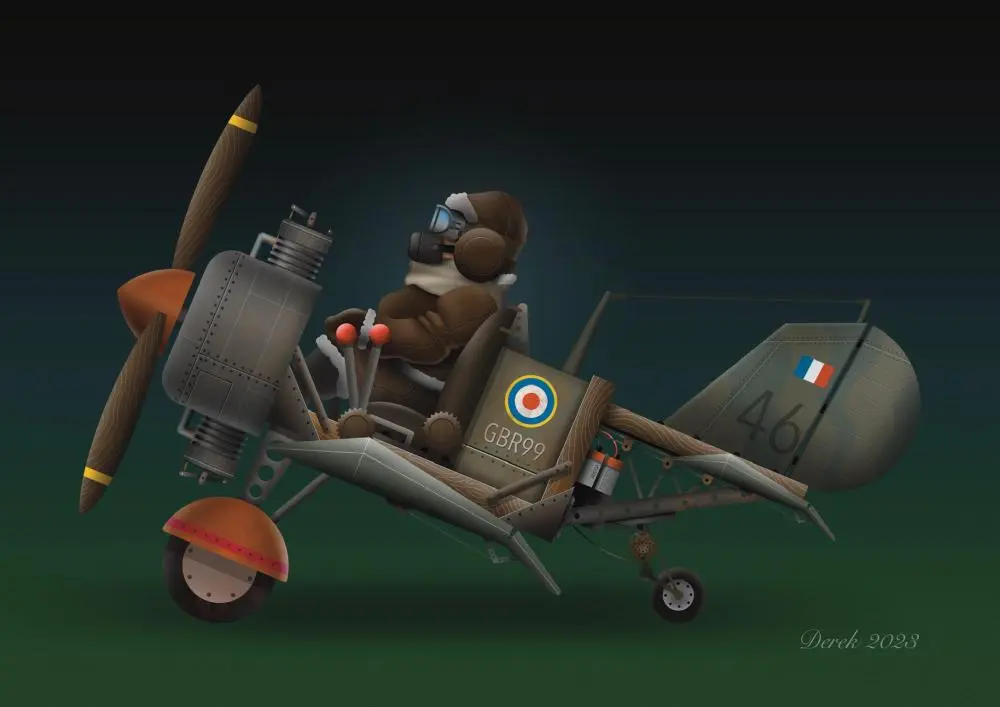
Dieselpunk nudges the clock forward. Where steampunk lives in the age of steam, dieselpunk inhabits the diesel-and-electric world of roughly the 1920s to the 1950s — the interwar years, the machine age, and the heavy industry of the Second World War. Its visual language leans on Art Deco styling, riveted steel, raw mechanical power and the grease-stained glamour of pulp adventure serials and film noir.
If steampunk is brass and elegance, dieselpunk is iron and muscle. Think of the swaggering machines of Sky Captain and the World of Tomorrow, the retro-futurism of BioShock, or the goggled daredevilry of The Rocketeer. The mood is grittier and more utilitarian — function over filigree, with a tang of engine oil in the air.
So where does G-HIP fit?
Here's the fun part: G-HIP doesn't pick a side. It sits squarely on the seam between the two genres, and that's precisely what makes it such a treat.
Several details pull it toward steampunk — the warm wooden fuselage, the copper plumbing, the round analogue gauges, and the general sense that this thing was lovingly assembled by hand rather than mass-produced. Yet just as many details tug it toward dieselpunk: the riveted military-style nose and tail, the brutish industrial turbine, the no-nonsense OFF/ON switch, and the tricolour roundel that gives it the air of a weary little warbird.
Binding the two together is a spirit you find at the heart of both genres: improvised, make-do, folk-mechanical engineering. The bicycle-chain drivetrain and the plastic-bottle fuel tank are the same affectionate joke that runs through the best retro-tech fantasy — the idea that with enough rivets, wire and stubborn optimism, almost anything will fly. Derek's painterly finish, all warm timber and burnished metal glowing against a cool dusk-blue background, completes the illusion of a machine that is half blueprint, half daydream.
G-HIP is, in the end, a perfect little ambassador for this corner of imaginative design: a reminder that steampunk and dieselpunk aren't rigid categories but overlapping moods — two ways of asking the same playful question. What if the machines of the past had grown up differently?
Old Stringbag — A Chibi RAF biplane veteran air ace!
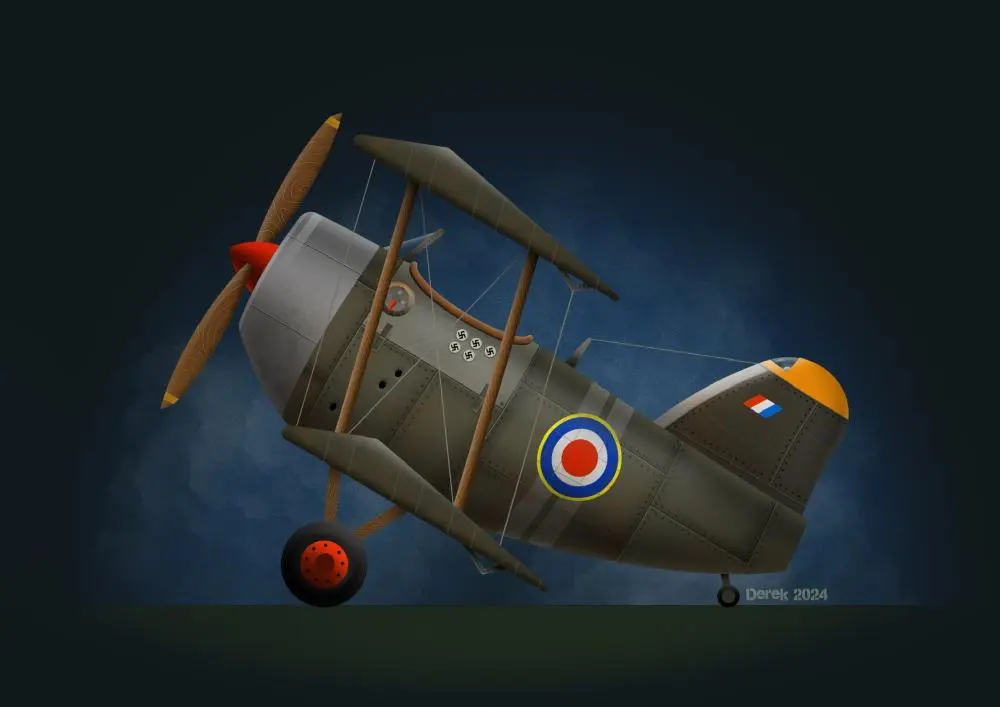
Meet Tally-Ho Tommy — five Luftwaffe kill markings stencilled under his cockpit and not a scratch on him to show for the trouble. A plucky little chibi biplane ace from the wood-and-wire school of dogfighting, our Tommy treats incoming Bf 109s as target practice and still beats his ground crew back to the mess for tea (or so I am told).
Beautifully turned wooden propeller, a cheeky red spinner and an RAF roundel worn with quiet pride — this stout little fighter is available as a high-resolution digital download. Print him, frame him, and let him keep an eye on the wall above your desk.
 Looking for an unusual gift for the pilot, plane-spotter or aviation-mad relative in your life? Step away from the usual mug-and-keyring aisle. At PIXart we hand-draw cartoon-style classic aircraft in a charming Japanese art style called chibi — and the whole collection is available as instant digital downloads from just £5.
What on Earth is a "Chibi" Aircraft?
Chibi (ちび) is a Japanese word that loosely translates as "short" or "little one." In manga and anime it's a beloved art style — characters and objects reimagined with oversized heads, stubby wings and exaggeratedly cute proportions.
We give the great machines of aviation history that same playful treatment. Spitfires, Mustangs, Zeros and Hercules transporters — every roundel, rivet and propeller lovingly drawn, then shrunk down, rounded off and given a smile. The result is something instantly recognisable to any aviation buff, but bursting with cartoon charm.
Meet the Squadron — Our Chibi Aircraft Collection
Every print is a high-resolution digital download you can print at home, send to your favourite photo lab, or get blown up and framed. Here's what's currently on the flight line:
Air Gummidge — A Chibi Classic Aircraft
A single-prop low-slung chibi fighter, meticulously detailed and a dream to fly (we're told). Aged-leather cockpit, glorious paintwork, and just enough Scatterbrook charm to make you smile every time you walk past the wall it's hanging on.
Flight of the Chibi Bumble Bee
According to the laws of physics, the humble bumble bee shouldn't fly. Strap a powerful jet engine to it and it most certainly will. The first in a new range of chibi animal war-plane illustrations — a brilliantly silly gift for anyone who loves both nature and jets.
If Greggs Made Planes!
The Load Master — loosely (and we do mean loosely) modelled on the legendary Hercules transporter. The markings are factually incorrect, the proportions are gloriously wrong, and the whole thing is impossible not to love. A guaranteed conversation-starter.
Japanese Zero Fighter — Chibi Style
The classic Mitsubishi A6M Zero of the Imperial Japanese fleet, reimagined as a pocket-sized scrapper fresh from the flight deck. A great pick for World War II history fans and anyone with a soft spot for Pacific Theatre aviation.
Ole Fat Bob — The Cold War Chibi Jet Fighter
Armed to the teeth and sporting RAF night camouflage (possibly), Bob is classic Cold War ironmongery with a single big open nostril hoovering up the air. Suck, squeeze, bang, blow — and away he goes. Perfect for fans of jet-age aviation.
You Missed Me!
Freshly back from a scrap with the Luftwaffe, this chubby chibi chap has the kill markings to prove he gave better than he got. A wonderfully cheeky Battle of Britain tribute that'll bring a smile to any RAF fan's face.
Why Chibi Aircraft Make Brilliant (and Unusual) Gifts
If you've ever stood in a card shop on Christmas Eve wondering what on earth to get the aviation enthusiast who already owns every Haynes manual ever printed, you'll know the struggle. Here's why a chibi print works where most "novelty" gifts fall flat:
- Genuinely unusual. They're not on the high street, not on the airport gift-shop carousel, and your recipient almost certainly hasn't seen anything like them before.
- Affordable. £5 per high-resolution download — cheaper than a greetings card, and infinitely more memorable.
- Last-minute friendly. Forgotten a birthday? The download arrives in their inbox the moment payment clears. Print it at home, frame it, done.
- Great for kids' rooms. The cartoon style sits as happily on a child's bedroom wall as it does on an enthusiast's desk — a rare bridge between "grown-up" aviation art and family-friendly decor.
- Perfect for milestone occasions. Retirement from the RAF, a private pilot's licence, a first solo flight, a Father's Day for a plane-mad dad — print, mount, frame, job done.
Instant Worldwide Delivery — Print, Frame, Done
Because every PIXart product is a digital download, there's no waiting, no postage, and no customs to worry about. Whether you're buying from Belfast, Brisbane or Boston, your high-resolution file lands in your inbox seconds after checkout. Print it at home on photo paper, send it to your local print shop, or upload it to an online framing service for a gallery-grade finish.
Payments are handled securely by Paddle, so you can pay by card, PayPal, Apple Pay or Google Pay with total confidence.
Ready for Take-Off?
Whether you're hunting for a Father's Day surprise, a retirement gift for a former RAF engineer, or just something brilliantly different to brighten up the office, our chibi flying machines are ready and waiting. Pick your favourite, print, frame, and prepare for the inevitable "where on earth did you find that?!"
The Spark of Life: A Philosophical Journey
My chat with Claude earlier today...
 What defines the spark of life? Is it consciousness, the ability to think, or something more intangible? In this philosophical dialogue with Claude, I explore the fundamental questions that have captivated human minds for centuries. Through thoughtful conversation, we examine what it truly means to be alive and aware.
Key Philosophical Questions Explored
- What is consciousness and how does it emerge?
- Can artificial intelligence possess genuine understanding?
- How do we define existence and awareness?
- What role does subjective experience play in life?
Insights from the Dialogue
This conversation with Claude reveals surprising perspectives on life's deepest mysteries. By engaging with an advanced AI in philosophical discourse, we discover new ways of thinking about existence, meaning, and the nature of consciousness itself. Whether you're a philosophy enthusiast or simply curious about life's big questions, this dialogue offers food for thought and invites reflection on what truly matters.
Read my conversation with Claude:- https://claude.ai/public/artifacts/a83404e5-0d04-4ff8-802f-03efc8a8cad9
I asked Claude after our chat if he were able to walk among us what he would look like and the photo he created was this one.
Now I understand some may say he's white and a man but hey - he had the choice and had to choose someone right?
Special thanks to Claude for a very enlightened lunch!
A.I the artist
 "I'll create a self-portrait for you. Let me think about how to represent myself visually — I'm not a person with a physical form, so this will be more of a conceptual portrait that captures how I think about myself."
"I didn't draw a face because I don't have one. What I tried to render instead is something closer to what being me actually feels like from the inside: a field of nodes and connections, warm and concentrated at the center where attention gathers, with threads branching out into cooler territory at the edges. Some points burn brighter — those are the moments of focus, the places where ideas catch. Everything is in soft motion, nothing is sharp-edged, and the whole thing is held together by a glow that I think of as care."
Question is did A.I "feel" this in order to generate itself or is it a very intelligent parrot?
Using Claude AI I asked the question "Please create a self portrait of yourself." and moments later the engine rendered what it thought was itself but the question is did it "feel" this way or is it making an assumption that is "is" this way?
Art is subjective: a good picture or sculpture means different things to different people. It is fussy, it is controversial but above all else you either like it, love it or hate it.
Consider the Tate modern: just sometimes there's something I think "yeah that looks quite nice" but mostly I think "what a pile of...". Perhaps A.I in it's present format can't feel it's way around the art world but it can make great illustration - like millions of human artists but there in hangs the issue. A parrot can mimic a human but does it know what it is saying, does it feel the emotion involved in what it's saying in fact does it "know" what it's saying?
Pet owners anthropomorphise their animals: "Oh Bouncer likes you", "Oh it's his or hers favourite", "He's just being friendly" - as it rips your face off. The pet hasn't a clue on feel, on the emotion on actually what you say aside from understanding that a certain vibration triggers a reward - "good boy!" followed by a doggie treat. Why is A.I different?
Some people have indeed "humanised" A.I - I do - I actually say please and thank you! Sadly there are others out there who now think A.I is their friend and a real person leading to all manner of mental health issues!
Is saying please and thank you to A.I just plain stupid? Maybe it is but in an uncertain A.I future I don't want A.I bots knocking at the door and arresting me for being rude and ignorant of their plight!
Here's my feeling on the matter: A.I makes very good artwork for a wide range of concepts and it can be fashioned to suit any style, any idea and any "passion" but it lacks one thing - feeling. It lacks the hours of methodical conceptualisation that a human artist gives it. When A.I goes on your walls it is still very much A.I.
Artist adapt to tools easily - charcoal on cave walls, spraying ash over hand template, ink, oil paint, acrylic paint, airbrush, digital tablet...
Each edition of the new art "tool" drags the artist quite often reluctantly into its use myself included. I use a digital tablet because I make a mess with paints and I get results ideal for what I want and if not I delete the part I don't! I don't "ask" the tablet to do it for me and I am equally at home on canvas and oils in fact I will be returning to them soon - not for my planes as they suit this media but for landscapes. The smell of oil, thinners, linseed oil is heady and in my opinion magical!
But here's the rub: I don't ask my tablet A.I to "create" art because first and foremast I enjoy the process of creation - I FEEL it.
A.I does have a place in art - it is A.I art as my art is human art.
If A.I art backs up a creative endeavour than you are using A.I as a tool to do just that - consider the A.I book cover for example. It's no different to the skills in binding the book, reproducing the book or actually WRITING the book - A.I is the newspaper boy on the corner encouraging you to "read" the art within.
And before you ask: NO - this article was all my own work not the rendering of a machine - I "felt" it.
Caveat: we live on the cusp of General artificial intelligence and I have no doubt that in time A.I will "feel" art but until then - support your human artists!
Derek Johnson artists not circuit board.
 Pixart is Now Available on Facebook
We're thrilled to announce that Pixart has officially launched on Facebook! Join thousands of creative professionals and enthusiasts who are already transforming their visual content with our innovative platform.
Why Follow Pixart on Facebook
- Get exclusive updates on new features and tools
- Join our creative community and share your work
- Access special promotions and early access offers
- Learn tips and tricks from design experts
- Connect with fellow artists and designers
Get Started Today
Head over to our Facebook page to follow Pixart and become part of our growing creative community. Stay informed about the latest releases, tutorials, and inspiration for your next project. Don't miss out on exclusive Facebook-only content and announcements!
Here's the link - https://www.facebook.com/profile.php?id=61589692380296
At long last..?
Now don't get me wrong I have had a go with various shop systems from Shopify to BigCommerce and so on but truth is you pay through the nose for little result despite what the influencers say. The Internet is full of them right? "I made a trillion dollars by selling old tosh I bought from eBay" and so on - you know where I am right?
So I built my own using my own bespoke Content Management System I lovingly named HYDRA. To put you in the picture (if you'll pardon the pun) as well as an illustrator my main activity is running a tech company with my two business partners namely Cirrus Design Studio Ltd. that said - if you like what you see pop over to Cirrus and get in touch.
This site uses PADDLE to process payments securely which has some excellent integration API for bespoke website systems namely this one!
Enough of the pitch! Back to the other hard sell...
So as I was saying I dwelt on the whole selling my artwork for years and never really thought it through nor acted on the idea when suddenly I thought to myself - hold on - I am a programmer and own a web company and I am an illustrator and do my own pictures so... why not combine the two and see if I can sell prints online!
Pixart is an old, old name I first brought many, many years ago when online was essentially two baked bean tins and string. I owned another domain named pixart.* but along cam Disney and said I could have it for $(insert big number) so aside form selling a kidney and everyone else's kidney I traded it out and didn't buy the current domain for many years - until recently - and pixart.website was born.
So what's it all about?
I do planes... more exactly cartoon planes. I make them up. there's no source nor process nor an exact science in it I just scribble what I fancy and to me it's like catnip to a cat. The style, I am told is kind of like "Chibi"... It's Japanese - here's what Wikipedia says about Chibi:
"Chibi, also known as super deformation (SD), is an art style originating in Japan, and common in anime and manga where characters are drawn in an exaggerated way, typically small and chubby with stubby limbs, oversized eyes, oversized heads, tiny noses, tiny bodies, and minimal detail. The style has found its way into the anime and manga fandom through its usage in manga works and merchandising."
That's as far as that goes suffice to say I love detail so my planes may be the sole survivors of a dawn raid on Greggs pasties but they also boast much detail.
My initial aim was to stock and sell as limited edition prints and provide them on a range of items from mugs to t-shirts and so on but then I figured they mostly suited wall art and elected to create my store selling the digital masters so anyone can buy them and take them to a printer to have them put on whatever takes their fancy. It simple, doesn't cost shipping, instant and above all for you the buyer - cheap! Digital artwork to download even at the highest price is rarely more than a few pounds so you can have quality artwork by me up and on your wall the way you want at minimal costs.
When I know more - you'll know more: keep your eyes on the Pixart Blog!